Campus maintenance needs a shared location reference and a clear receiving team when one reported problem crosses building, grounds and utility responsibilities. A common map is useful only when it helps someone accept and complete the next action.
Trimble names educational systems among Maintain’s application areas. The campus coordination design below is an original proposal to validate, not a report of an InfoGraph university implementation. Current Maintain overview.
Build a responsibility map
| Layer of responsibility | Question for the pilot |
|---|---|
| Building | Who receives an occupant’s report? |
| Shared utility | Who assesses a problem affecting more than one building? |
| Grounds | Who restores the surrounding path or landscape? |
| Contractor | Who confirms the accepted scope and completion? |
| Data steward | Who updates asset identity or location after the work? |
Use actual teams rather than these example labels. Agree how a transfer is acknowledged so that a forwarded record does not become an unowned task.
Worked example: a report outside the library
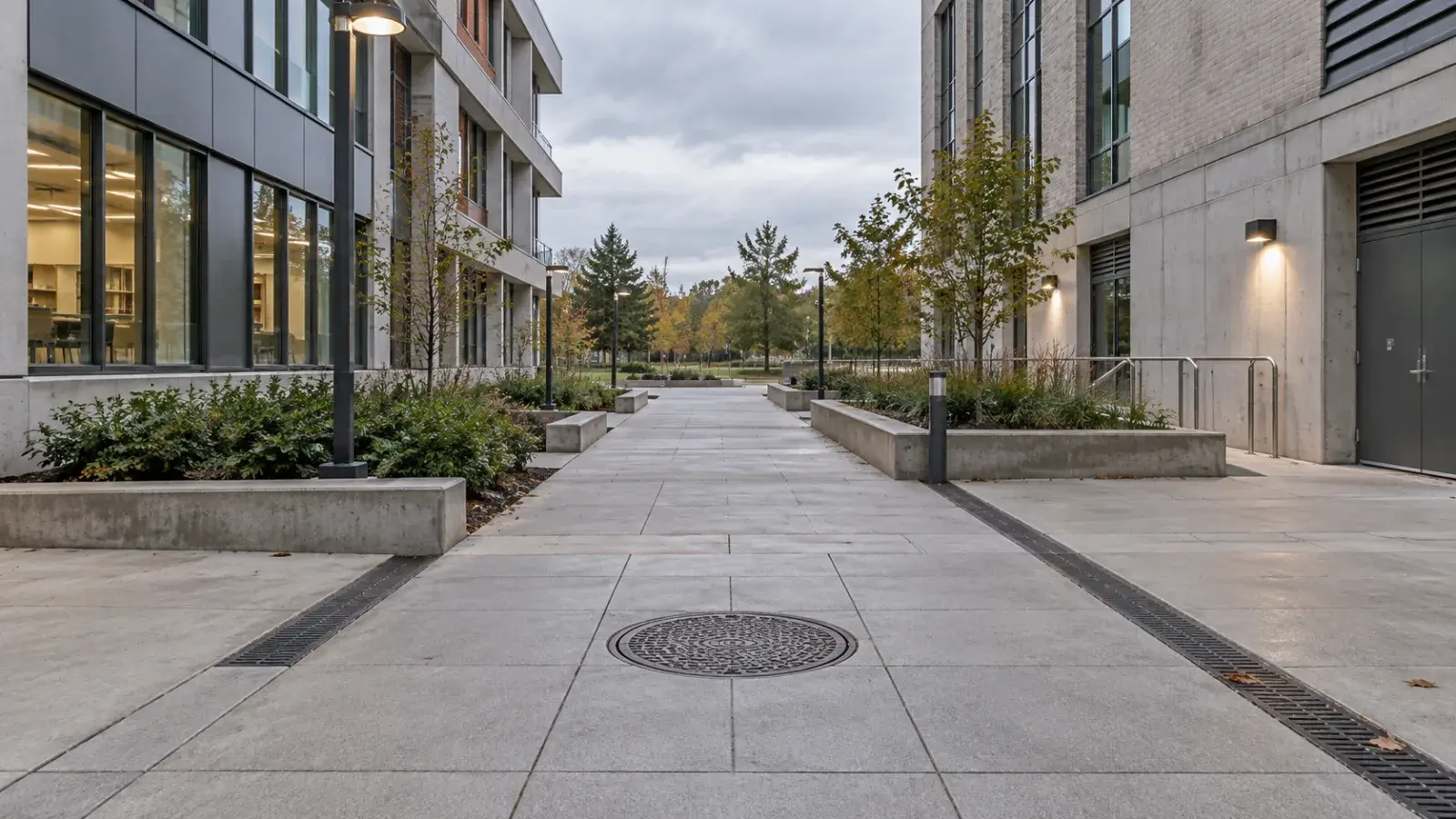
In a hypothetical campus, a wet patch is reported beside the library. The location causes the report to reach the building team, but assessment identifies a shared utility asset beneath the path. The utility team accepts the investigation, while the grounds team may later own surface restoration.
Keep the original location and report reference. Record the confirmed asset, receiving team and agreed handoff. When the utility intervention is accepted, retain any separate restoration task until its responsible team accepts the result.
The important distinction is between the building associated with the report and the asset responsible for the maintenance action. Do not force a shared network asset into a single building’s history merely because that building supplied the first complaint.
Make room for changing campus names
Buildings may have formal names, common names and Arabic/English labels. Use stable identifiers beneath those labels and record useful aliases. Test whether a newly renamed building can still be found through an older report.
Do not use a renamed room or building as a reason to overwrite equipment identity. Location, ownership and equipment replacement are different changes with different evidence.
What should the pilot prove?
Ask a reviewer to trace the library report through reassignment, confirmed utility asset, accepted intervention and any remaining grounds work. Then ask which team owns the record correction. If responsibility becomes unclear at a boundary, refine the handoff before expanding to the entire campus.
Read the public-facilities asset guide for building-level records. This campus guide adds the cross-team responsibility problem rather than repeating the same equipment hierarchy.
Plan your next step
Review InfoGraph’s Trimble offering and GIS implementation services. Contact our team with a sample asset record and the decision you need the workflow to support. For GIS data and field-collection skills, explore the training catalogue and confirm the relevant course scope; a dedicated Maintain course is not assumed.