Evaluate solid-waste asset maintenance around identifiable equipment and documented repair decisions, such as containers or transfer-facility assets. This is a proposed fit assessment for Unity Maintain; the research behind this guide did not establish a sector-specific implementation or collection-routing capability.
The relevant documented foundation is asset and work management. The waste-equipment example below applies that general foundation as an editorial proposal, not as a verified packaged workflow. Trimble’s Maintain overview.
Separate the asset from its service location
| Record | Purpose |
|---|---|
| Physical asset ID | Identifies the actual container or equipment |
| Current placement | Shows where it is currently assigned |
| Defect observation | Records what requires assessment |
| Repair or replacement decision | States the approved next action and owner |
| Availability decision | Establishes whether it can return to the agreed service |
| Movement history | Preserves transfers without losing equipment history |
Use this as a pilot worksheet. Detailed repair practices and operational acceptance belong to the responsible technical team.
Worked example: a replacement container at the same point
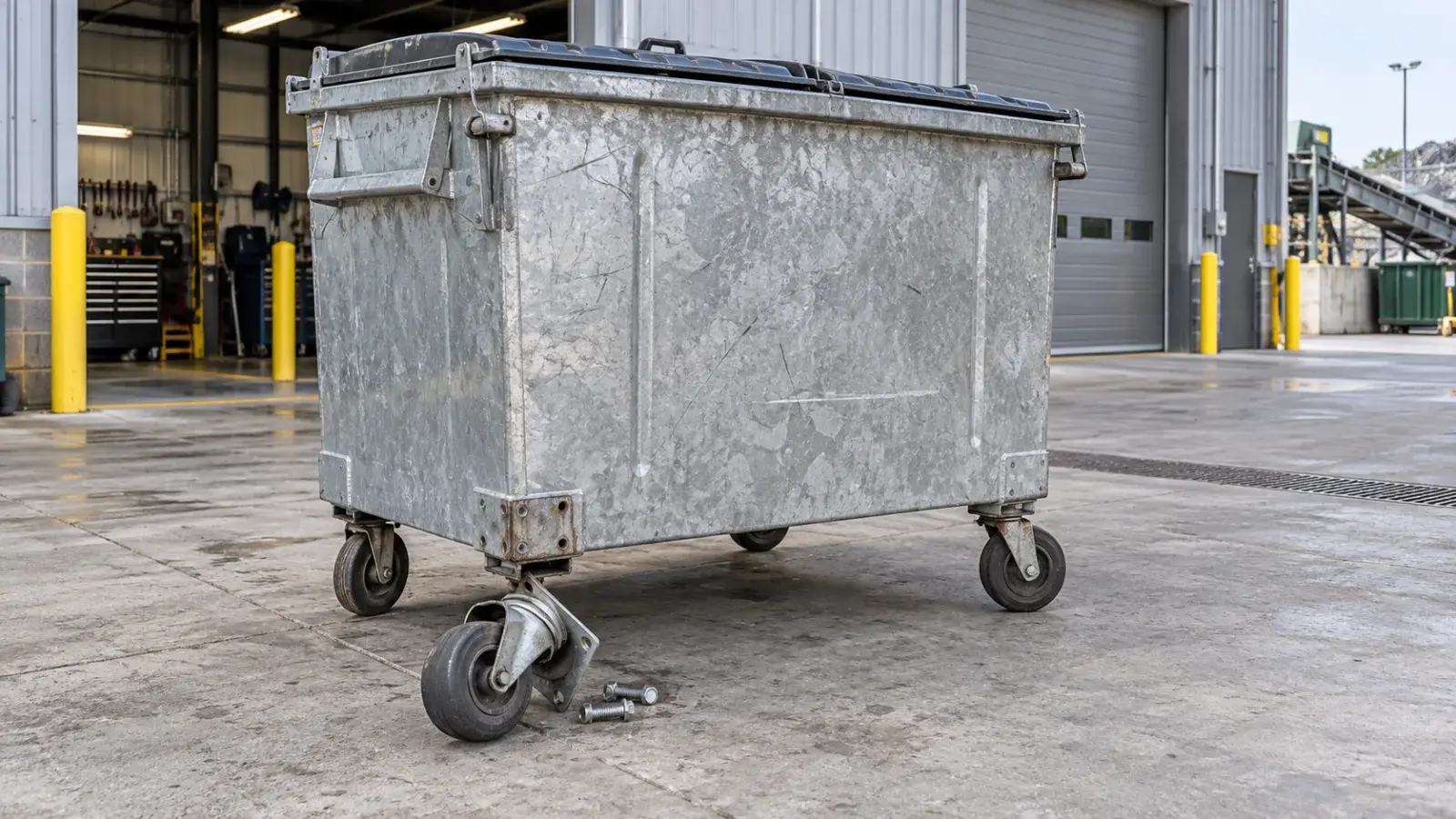
A hypothetical wheeled container at collection point CP-09 has a damaged caster. It is removed for assessment and another container is placed at the same point. If every maintenance record is attached only to CP-09, a later reviewer may attribute the damaged caster to the replacement.
Preserve the removed container’s identity, record its movement and keep its repair decision separate from the service location. The replacement receives its own placement relationship. When the original item returns, record that movement without overwriting either item’s previous history.
The example’s acceptance test is simple: starting from the collection point, identify the current container; starting from the removed container, retrieve the defect and repair outcome. These are different lookup questions.
Keep collection operations distinct
A completed container repair does not prove that a collection round occurred. Route optimisation, crew scheduling for rounds, weighing and service billing need independent requirements and evidence. Do not infer them from a successful equipment-maintenance demonstration.
If placement data is held elsewhere, specify who owns it and how changes reach the maintenance record. Test a delayed update so the team can recognise when a location is stale.
What would justify a wider rollout?
The pilot should demonstrate stable identity through movement, visible repair ownership and an accepted availability decision. If the team cannot identify equipment independently of its location, resolve that inventory gap first.
Use the GIS asset-readiness guide to decide which identifiers and lifecycle states must be reliable before configuration.
Plan your next step
Review InfoGraph’s Trimble offering and GIS implementation services. Contact our team with a sample asset record and the decision you need the workflow to support. For GIS data and field-collection skills, explore the training catalogue and confirm the relevant course scope; a dedicated Maintain course is not assumed.