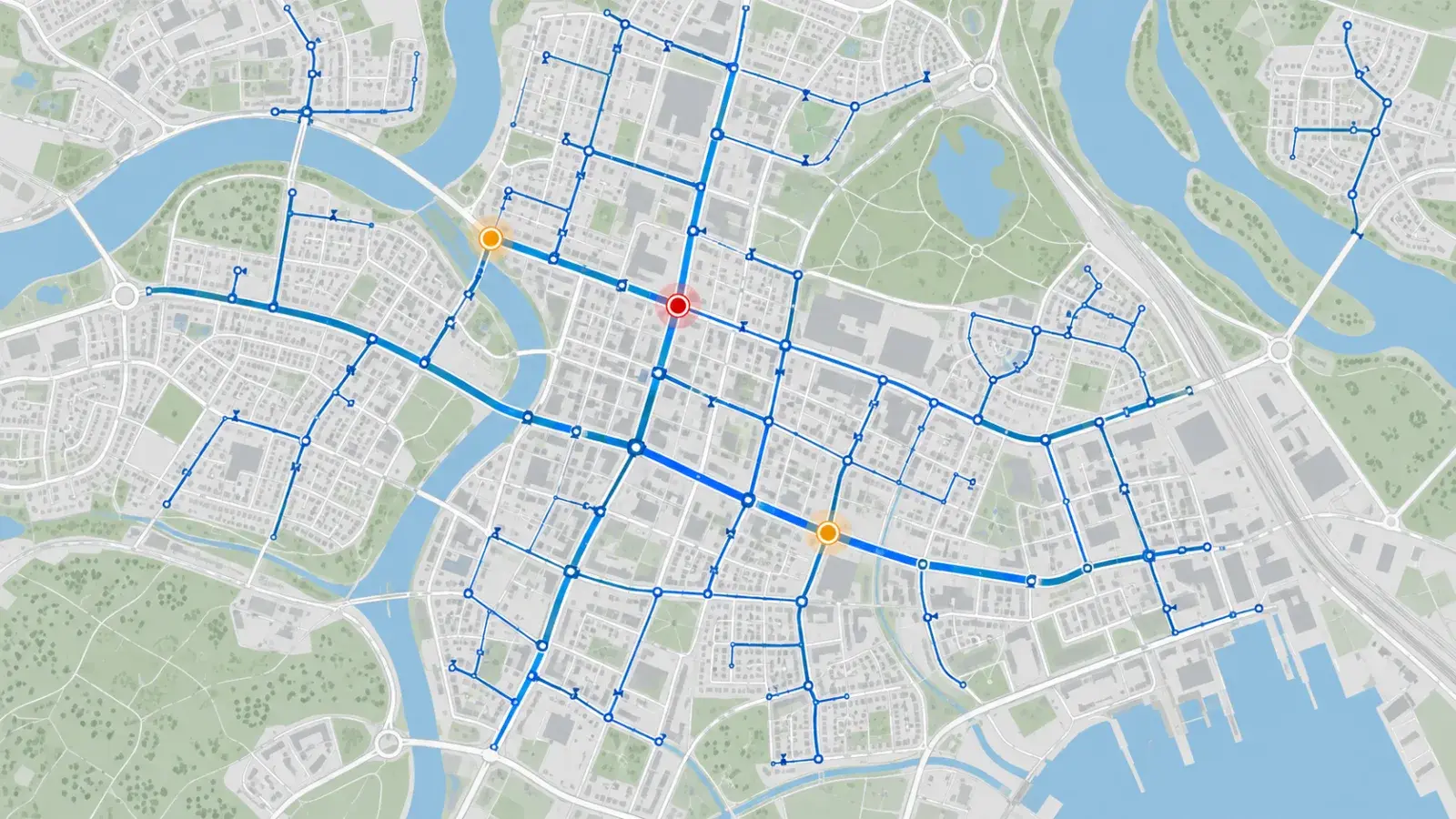
Prioritize water maintenance by explaining both the observed problem and the consequence of leaving it unresolved, then record how reliable that evidence is. A single score without those explanations can hide assumptions and make unlike tasks appear comparable.
Trimble lists Operational Insights among its Maintain guides. The decision sheet here is an independent planning exercise, not that module’s formula, a configured risk model or a validated engineering standard. Maintain documentation directory.
Build a decision sheet before a ranking
| Decision factor | Question to record | What not to assume |
|---|---|---|
| Condition evidence | What was observed, when and by whom? | Old observations describe today's condition |
| Service consequence | Who or what depends on the asset? | Every asset of the same type has equal consequence |
| Redundancy | Is an alternative actually available? | A mapped parallel route is operational |
| Evidence confidence | Which facts remain unverified? | Missing information means low risk |
| Readiness | What approvals, access or resources are needed? | A high priority makes a task executable immediately |
| Decision owner | Who approves the action and next review? | A calculated score is an approval |
Worked example: two candidates, different decisions
Consider two synthetic candidates. Asset A has a confirmed defect with a verified service alternative. Asset B has an uncertain condition record but serves a function for which the team has not confirmed an alternative. The worksheet does not justify declaring B healthy because its defect evidence is incomplete.
A reasonable proposed outcome is to plan corrective work for A and assign an early evidence-gathering task for B. The responsible engineering team must decide their urgency using local requirements. The original contribution is the separation between “we need to repair” and “we need enough evidence to decide.”
Record the chosen action, rationale, approver and review trigger. If new information confirms that B has a working alternative, revisit the decision rather than preserving an obsolete priority merely for consistency.
Avoid a false precision trap
Do not multiply invented condition and consequence numbers and call the result objective risk. If an organisation chooses a scoring model, define scales, evidence requirements, missing-value rules and how different asset classes can be compared. Test whether a small input change reverses an important decision and have the decision owner review that sensitivity.
Turn priority into an executable task
A ranked list needs a responsible team, next action and acceptance evidence. Keep access or procurement blockers visible. Measure whether high-priority items gained an owner and a decision, not simply whether a dashboard has colour-coded them.
Use the water-network maintenance workflow to connect the approved action to a traceable asset and repair record.
Plan your next step
Review InfoGraph’s Trimble offering and GIS implementation services. Contact our team with a sample asset record and the decision you need the workflow to support. For GIS data and field-collection skills, explore the training catalogue and confirm the relevant course scope; a dedicated Maintain course is not assumed.